
The Lawgicals
Beyond Boundaries, Within the Law
Beyond Boundaries, Within the Law

Blackmail and extortion cases involve threats, coercion, or unlawful demands for money, personal information, or other benefits. Victims facing online blackmail, cyber threats, or extortion should preserve evidence such as chats, screenshots, emails, and payment details before taking legal action.
The Lawgicals provides legal assistance for blackmail, extortion, criminal intimidation, cyber harassment, and related criminal complaints in Delhi, Gurgaon, and Delhi NCR. Legal support may include complaint drafting, police assistance, cyber complaint guidance, and case strategy.
ब्लैकमेल और एक्सटॉर्शन ऐसे मामले होते हैं जिनमें किसी व्यक्ति को धमकी देकर पैसे, निजी जानकारी या अन्य लाभ लेने की कोशिश की जाती है। यदि कोई आपको ऑनलाइन ब्लैकमेल कर रहा है, धमकी दे रहा है या जबरन पैसे मांग रहा है, तो सभी सबूत सुरक्षित रखना आवश्यक है।
The Lawgicals दिल्ली, गुड़गांव और दिल्ली NCR में ब्लैकमेल, एक्सटॉर्शन, क्रिमिनल इंटिमिडेशन, साइबर ब्लैकमेल और संबंधित आपराधिक मामलों में कानूनी सहायता प्रदान करता है। इसमें शिकायत ड्राफ्टिंग, पुलिस कंप्लेंट गाइडेंस और कानूनी रणनीति शामिल हो सकती है।
Being accused of blackmail or facing an extortion-related issue can be stressful and confusing. In many situations, individuals receive threats over phone calls, WhatsApp messages, emails, social media platforms, or other online channels demanding money, confidential information, or personal favours.
Blackmail and extortion cases may involve threats to leak private photos, publish sensitive information, damage reputation, file false complaints, or cause physical harm unless certain demands are fulfilled. Such conduct can have serious legal consequences under Indian criminal law.
Victims of blackmail, cyber threats, criminal intimidation, or extortion should act carefully, preserve evidence, avoid panic payments, and seek timely legal guidance. Understanding the available remedies can help in protecting your rights and taking appropriate action.
Blackmail generally refers to situations where a person threatens to reveal private information, personal photographs, confidential business data, private chats, videos, or sensitive documents unless money, favours, or some other benefit is provided in return.
In practical terms, blackmail is not limited to personal relationships or social media misuse. It can also arise in business environments where an individual threatens to damage someone’s reputation, file false complaints, disclose confidential commercial information, or circulate false allegations unless a financial demand is fulfilled.
Extortion usually involves unlawful demands backed by threats, fear, intimidation, or coercion. The threat may relate to personal safety, bodily harm, business disruption, reputational damage, social humiliation, false criminal implication, or exposure of private information.
For example, a shopkeeper may be threatened by local criminals demanding monthly “protection money” in exchange for allowing the business to operate peacefully. Similarly, a businessman may receive calls or WhatsApp messages demanding payment while threatening violence, kidnapping, reputational harm, tax complaints, or interference with business operations.
Common real-world examples include threatening to leak private chats, demanding money to avoid publishing personal photos, extorting payments from business owners, forcing commercial settlements through threats, or pressuring individuals by threatening false allegations or police complaints.
Extortion today is no longer confined to offline threats. Many cases now involve online blackmail, fake legal notices, impersonation, cyber threats, hacked social media accounts, fake video calls, and so-called “digital arrest” scams where fraudsters impersonate law enforcement or government officials to unlawfully obtain money.
In a significant judgment, the Supreme Court clarified that actual payment or transfer of money is not always necessary to attract extortion-related offences. In M/S Balaji Traders v. State of U.P. & Anr., the Court observed that merely putting a person in fear of death or grievous hurt for the purpose of extortion may itself constitute an offence, even if money was ultimately not paid. This reinforces the principle that threats themselves can trigger criminal liability in serious cases. :contentReference[oaicite:0]{index=0}
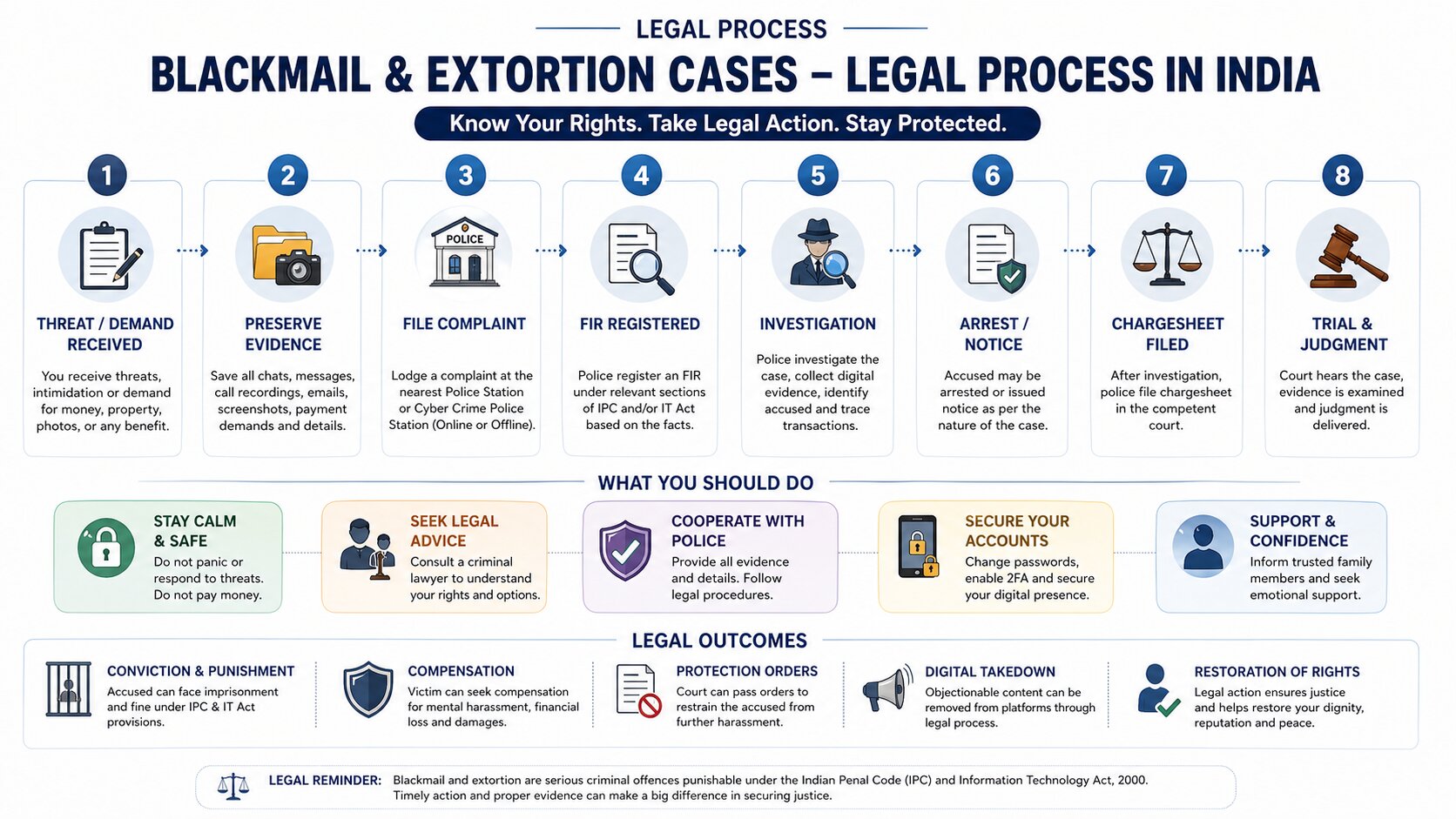
With the growing rise of cyber blackmail, business extortion, and digital intimidation, individuals facing such threats should preserve all available evidence including chats, screenshots, call recordings, payment requests, bank details, usernames, URLs, and related communication before initiating legal action.
Victims may have multiple legal remedies depending on the nature of the conduct. A lawyer can help assess whether the matter involves extortion, criminal intimidation, cyber harassment, defamation, stalking, or related offences.
Legal action may include filing a police complaint, submitting a cyber crime complaint, preserving digital evidence, issuing notices where appropriate, and pursuing further remedies based on the facts of the matter.
If you are facing blackmail or extortion, preserve all relevant evidence including screenshots, emails, chats, call logs, payment demands, social media links, and recordings where legally available.
A complaint may be filed before the local police station or cyber crime authorities with complete incident details and supporting material. Early reporting often improves the ability to investigate and respond effectively.
A large number of blackmail cases now arise online through social media, dating apps, fake profiles, hacked accounts, impersonation, email threats, or compromised personal data.
Cyber blackmail can escalate quickly if victims panic or make repeated payments. It is generally advisable to document everything carefully and obtain legal advice before responding further.
Evidence plays an important role in blackmail and extortion matters. Victims should preserve WhatsApp chats, Telegram messages, email headers, screenshots, account details, transaction records, URLs, usernames, and any threatening communication.
Avoid deleting chats or blocking accounts immediately unless necessary for safety, as this may affect future evidence collection.
You should consider legal consultation if threats are increasing, money is being demanded, personal content is being misused, or you are unsure how to proceed with a complaint.
Professional legal guidance can help structure the complaint correctly, identify relevant remedies, and reduce procedural mistakes in sensitive criminal matters.
Adv. Ravi Shankar Dwivedi
🌐 www.thelawgicals.co.in
📧 ravidwivedi@thelawgicals.co.in
📞 9084311136