Cheque Bounce Case Lawyer in Gurgaon – Section 138 NI Act Advocate
Voice Search Summary (English)
A cheque bounce case under Section 138 of the Negotiable Instruments Act is a criminal offence in India. If a cheque issued for a legally enforceable debt is dishonoured due to insufficient funds or other reasons, the payee has the right to take legal action.
The process involves sending a legal notice within 30 days and filing a complaint if payment is not made within 15 days. A cheque bounce lawyer in Gurgaon can help you handle the legal procedure, ensure proper documentation, and recover your money efficiently.
वॉइस सर्च सारांश (Hindi)
चेक बाउंस का मामला भारत में नेगोशिएबल इंस्ट्रूमेंट्स एक्ट की धारा 138 के तहत एक आपराधिक अपराध है। यदि किसी वैध देनदारी के लिए दिया गया चेक बैंक द्वारा अस्वीकृत हो जाता है, तो प्राप्तकर्ता कानूनी कार्रवाई कर सकता है।
इस प्रक्रिया में 30 दिनों के भीतर लीगल नोटिस भेजना और 15 दिनों के अंदर भुगतान न होने पर कोर्ट में केस दाखिल करना शामिल है। गुड़गांव में एक अनुभवी चेक बाउंस वकील आपकी मदद कर सकता है ताकि आप सही प्रक्रिया अपनाकर अपना पैसा वापस प्राप्त कर सकें।
A cheque bounce case can seriously impact your financial rights and business credibility. If you are dealing with a dishonoured cheque in Gurgaon, it is important to take timely legal action under Section 138 of the Negotiable Instruments Act, 1881. An experienced cheque bounce case lawyer in Gurgaon can help you issue a proper legal notice, initiate court proceedings, and recover your rightful amount efficiently.
When a cheque issued to you is returned unpaid by the bank, it is not just a financial inconvenience but a legal issue. Many people are unaware that cheque bounce is a punishable offence under Indian law. If you are facing a cheque bounce matter in Gurgaon, taking timely legal steps is important to protect your rights and recover your money.
What Is a Cheque Bounce Case Under Section 138 NI Act?
A cheque bounce case arises when a cheque issued towards a legally enforceable debt or liability is returned unpaid by the bank due to reasons such as insufficient funds, account closure, or signature mismatch. Section 138 of the Negotiable Instruments Act makes cheque dishonour a criminal offence, provided all legal requirements are fulfilled.
Legal Process for Filing a Cheque Bounce Case in Gurgaon
The legal process begins with sending a mandatory legal notice to the cheque issuer within 30 days of receiving the bank return memo. If the payment is not made within 15 days of receiving the notice, a criminal complaint can be filed before the Judicial Magistrate having jurisdiction in Gurgaon. Proper documentation and adherence to timelines are critical for a successful case.
Why You Need a Cheque Bounce Lawyer in Gurgaon
Cheque bounce cases involve strict statutory timelines and procedural compliance. A skilled cheque bounce lawyer in Gurgaon ensures that the legal notice is correctly drafted, evidence is properly presented, and court proceedings are handled effectively. Professional legal assistance increases the chances of early settlement or favourable court orders.
Penalty and Punishment for Cheque Bounce Cases
Under Section 138 of the NI Act, the accused may face imprisonment for up to two years, or a fine up to twice the cheque amount, or both. Courts may also encourage settlement between parties to resolve the matter efficiently and avoid prolonged litigation.
Consult a Cheque Bounce Case Lawyer in Gurgaon
If you are searching for a reliable cheque bounce advocate near you, consult Adv. Ravi Shankar Dwivedi for professional legal guidance. Timely action can protect your rights and help you recover your dues effectively. Call +91-9084311136 or email ravidwivedi@thelawgicals.co.in to schedule a consultation.
What Is a Cheque Bounce Case?
A cheque bounce occurs when a bank returns a cheque unpaid.
Common reasons include insufficient funds, account closure, or signature mismatch.
Such cases are governed by Section 138 of the Negotiable Instruments Act, 1881.
When Can You File a Cheque Bounce Case?
The cheque must be issued against a legally enforceable debt or liability.
The cheque should be presented within its validity period.
A legal notice must be sent within 30 days of cheque dishonour.
The drawer must fail to make payment within 15 days of receiving the notice.
Is Sending a Legal Notice Mandatory?
Yes, sending a legal notice is compulsory under Section 138 NI Act.
Without a legal notice, the court will not entertain the case.
The notice gives the other party a final opportunity to make payment.
Where Is a Cheque Bounce Case Filed in Gurgaon?
Cheque bounce cases are filed before the Judicial Magistrate Court.
Jurisdiction depends on where the cheque was presented or dishonoured.
Proper court selection is important to avoid dismissal on technical grounds.
Punishment for Cheque Bounce Under Section 138
Imprisonment up to two years.
Fine which may extend to twice the cheque amount.
In many cases, courts encourage settlement to resolve the dispute.
Why Consult a Cheque Bounce Lawyer in Gurgaon?
Strict timelines must be followed, otherwise the case may fail.
Correct drafting of legal notice is crucial.
A lawyer helps in proper presentation of documents and arguments.
Professional guidance improves chances of early recovery or settlement.
When Does a Cheque Bounce Case Arise?
When a cheque is returned unpaid by the bank due to insufficient funds in the account.
When the bank returns the cheque with remarks such as “account closed” or “payment stopped”.
When the signature on the cheque does not match the bank’s records.
When the cheque is issued towards a legally enforceable debt or liability.
When the cheque holder sends a legal notice within 30 days of dishonour.
When the drawer fails to make payment within 15 days of receiving the legal notice.
When Does a Cheque Bounce Case Not Apply?
When the cheque is issued as a gift or without any legally enforceable debt or liability.
When the cheque is post-dated and presented before its due date.
When the legal notice is not sent within the prescribed 30-day time limit.
When payment is made within 15 days of receiving the legal notice.
When the cheque is returned due to technical reasons not attributable to the drawer, such as bank errors.
When the cheque amount is not legally recoverable under law.
How to Avoid a Cheque Bounce Case
Always mention the correct reason or purpose on the back of the cheque, wherever applicable.
Never issue a blank cheque to anyone, even if the person is known or trusted.
Do not hand over a signed cheque without filling in the amount, date, and payee name.
Ensure sufficient balance is maintained in your bank account before issuing a cheque.
Immediately inform your bank in writing if any cheque is lost or misplaced.
Avoid issuing cheques as security unless absolutely necessary and legally documented.
Regularly check your bank statements to track issued cheques.
If a dispute arises, try to resolve it before issuing or presenting a cheque.
Common Mistakes People Make in Cheque Transactions
Issuing cheques without checking whether sufficient balance is available.
Giving blank or partially filled signed cheques as a matter of trust.
Not keeping a record of cheques issued and their purpose.
Ignoring bank messages or return memos related to cheque dishonour.
Assuming that stopping payment will automatically prevent legal action.
Delaying legal consultation after a cheque bounce or notice.
Difference Between Security Cheque and Payment Cheque
Security Cheque: Issued as a safeguard for future liability or performance of an obligation. It is not meant for immediate encashment.
Payment Cheque: Issued towards discharge of an existing and legally enforceable debt or liability.
A security cheque may still attract Section 138 NI Act if it is presented against a legally due amount.
Courts examine the purpose, timing, and supporting documents to decide the nature of the cheque.
What to Do After Receiving a Legal Notice for Cheque Bounce
Do not ignore the legal notice under any circumstances.
Check the details of the cheque, amount, and reason mentioned in the notice.
Consult a lawyer immediately to understand your legal position.
If the claim is correct, consider making payment within 15 days to avoid prosecution.
If the claim is disputed, send a proper reply through an advocate.
Preserve all documents, bank statements, and communication related to the cheque.
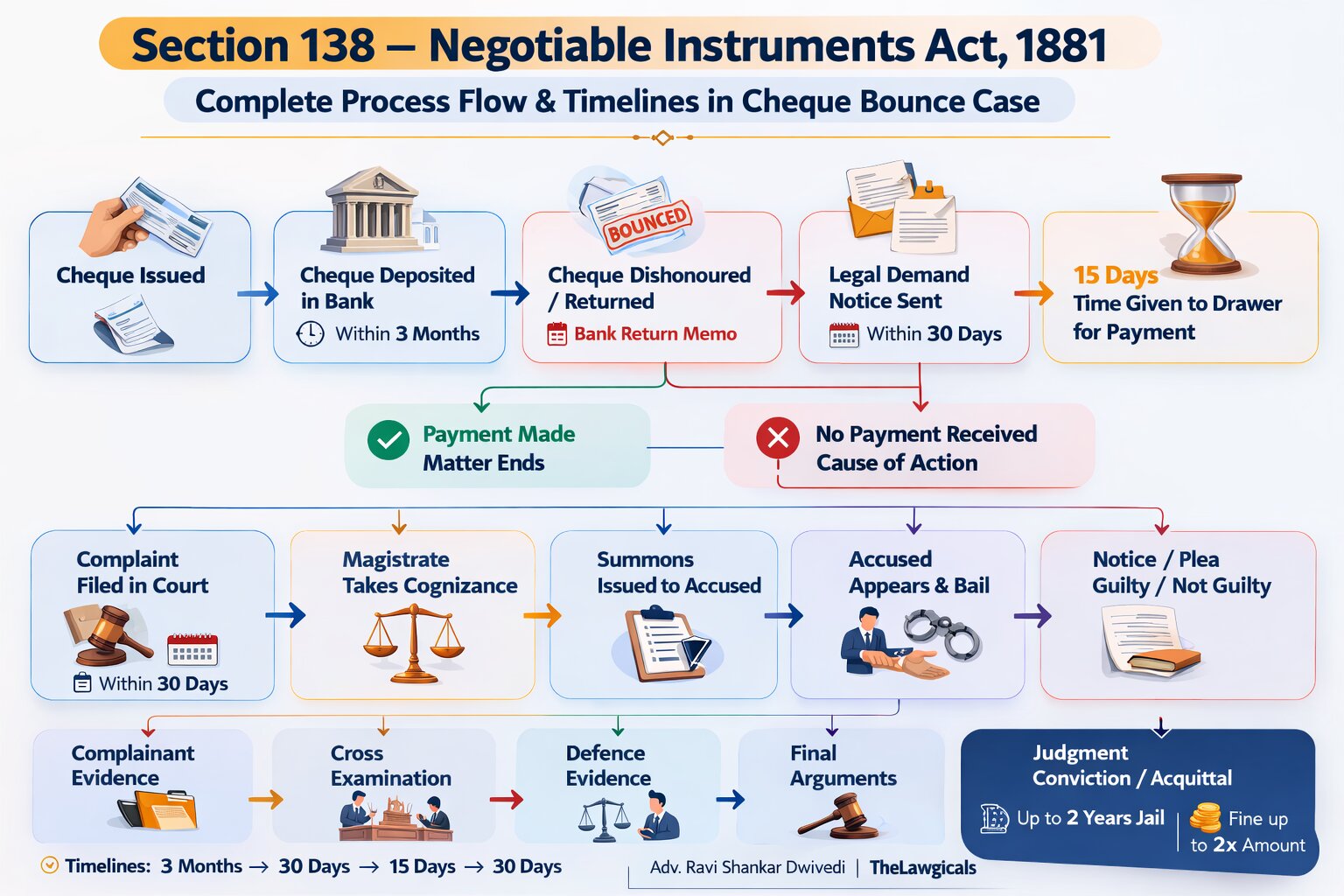
Day-wise Legal Timeline for Cheque Bounce Case
Day 1: Cheque is presented to the bank by the payee.
Day 2–5: Bank returns the cheque unpaid with a return memo stating the reason for dishonour.
Within 30 Days: Legal notice must be sent to the cheque issuer from the date of receipt of the return memo.
Next 15 Days: Time given to the drawer to make payment after receiving the legal notice.
After 15 Days: Cause of action arises if payment is not made.
Within 30 Days Thereafter: Complaint under Section 138 of the NI Act must be filed before the Magistrate.
First Hearing: Court examines the complaint and documents and may issue summons.
Trial Stage: Evidence, cross-examination, and arguments take place.
Final Stage: Court passes judgment or records settlement between parties.
Step-by-Step Cheque Bounce Case Process in Gurgaon under Section 138 NI Act
Do’s and Don’ts
Do’s
Keep the original cheque, bank return memo, and all related documents safely.
Send the legal notice within 30 days from the date of cheque dishonour.
Maintain proof of delivery of the legal notice.
Consult a lawyer at an early stage to avoid missing statutory timelines.
Be open to settlement if the other party is willing to make payment.
Don’ts
Do not delay in issuing the legal notice after cheque bounce.
Do not rely only on oral promises for payment.
Do not lose or damage the original cheque and return memo.
Do not file the case without proper legal advice.
Do not ignore court summons or hearing dates.
FAQs
Is cheque bounce a criminal offence?
Yes. Cheque bounce is a criminal offence under Section 138 of the Negotiable Instruments Act, 1881, subject to fulfilment of legal conditions.
Can a cheque bounce case be settled outside court?
Yes. Cheque bounce cases are compoundable and can be settled at any stage, even after filing of the case.
What documents are required for a cheque bounce case?
The original cheque, bank return memo, copy of legal notice, proof of notice delivery, and supporting transaction documents are required.
How long does a cheque bounce case usually take?
The duration depends on the facts of the case and court workload. Early settlement can significantly reduce the time.
Is it necessary to hire a lawyer for a cheque bounce case?
While it is legally possible to file the case personally, professional legal assistance helps ensure compliance with timelines and procedure.
Why Choose The Lawgicals?
Experienced advocates with practical exposure to cheque bounce and recovery matters.
Strong understanding of litigation, consumer disputes, and financial recovery cases.
Clear and transparent legal advice without false assurances.
Assistance available for matters across India, depending on jurisdiction.