
The Lawgicals
Beyond Boundaries, Within the Law
Beyond Boundaries, Within the Law

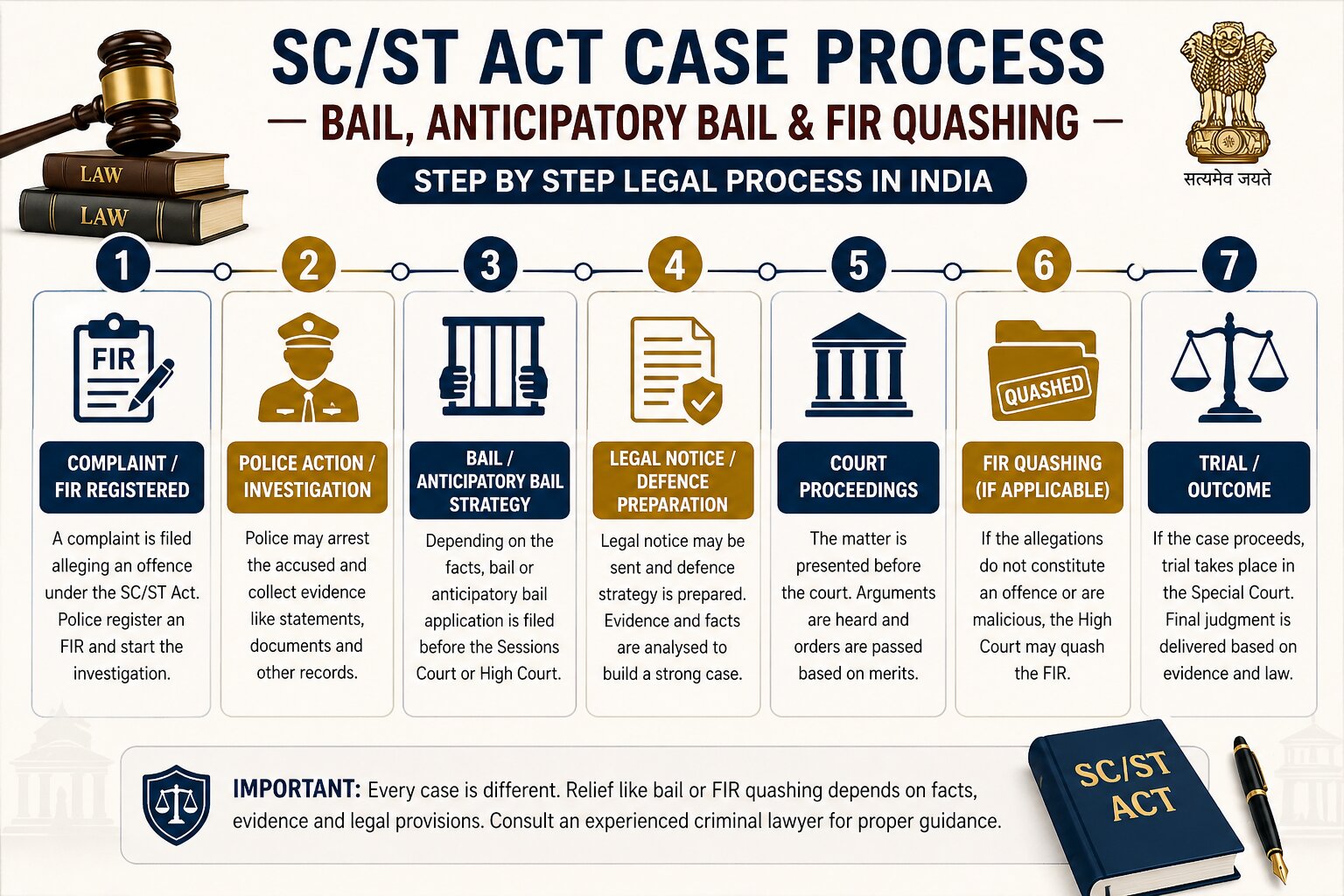
If you are facing an SC/ST Act case in Delhi or Gurgaon, it is important to act quickly. Bail may be possible depending on the facts, evidence, and whether a prima facie offence is made out under the law.
In many cases, disputes arise out of personal or property issues, and courts examine whether there was any intentional caste-based insult in public view. Legal advice at an early stage can make a significant difference in bail and FIR quashing.
अगर आप SC/ST Act के केस का सामना कर रहे हैं, तो समय पर सही कानूनी सलाह लेना बहुत जरूरी होता है। केस के तथ्यों और सबूतों के आधार पर बेल मिल सकती है, खासकर जब prima facie अपराध स्पष्ट नहीं बनता हो।
कई मामलों में विवाद व्यक्तिगत या संपत्ति से जुड़े होते हैं, जहां कोर्ट यह देखता है कि क्या वास्तव में caste के आधार पर public view में अपमान किया गया था। सही समय पर वकील से सलाह लेने से बेल और FIR quashing में काफी मदद मिलती है।
An SC/ST Act case refers to a criminal complaint filed under the Scheduled Castes and Scheduled Tribes (Prevention of Atrocities) Act, 1989. This law is designed to protect members of Scheduled Castes and Scheduled Tribes from acts of discrimination, harassment, and violence based on their caste.
The Act covers a range of offences, including intentional insult, intimidation, social discrimination, and other acts that target a person specifically because of their caste identity. These cases are treated seriously, and special courts are designated to handle such matters.
At the same time, for an offence to fall under the SC/ST Act, certain legal conditions must be satisfied. Courts examine whether there was a clear caste-based intention, whether the incident took place in public view, and whether the allegations are supported by specific facts and evidence.
Understanding these elements is important, especially in situations where disputes arise out of personal or property-related issues and later lead to criminal complaints. Each case depends on its own facts, and legal advice at an early stage can help in assessing the situation properly.
Facing an SC/ST Act case can be stressful, especially when the situation escalates quickly and legal options are not clear. Many people come to us with one common concern – whether bail is possible and how to defend themselves against serious allegations.
At The Lawgicals, we regularly handle SC/ST Act matters across Delhi and Gurgaon. Every case is different. Sometimes, the issue arises out of personal disputes, property conflicts, or misunderstandings that later turn into criminal complaints.
In this guide, we explain in simple terms how bail works in SC/ST Act cases, when anticipatory bail may be possible, and in what situations an FIR can be challenged before the High Court.
SC/ST Act cases are treated seriously under Indian law, and the consequences can be immediate. In many situations, people first come to know about the seriousness of the matter only after an FIR is registered or police action begins.
At the same time, every complaint does not automatically result in a strong case. Courts carefully examine whether the essential ingredients of the offence are present, including whether there was a caste-based insult, intention to humiliate, and whether the incident took place in public view.
One of the first concerns in such cases is whether bail can be obtained. While the law places certain restrictions, courts still grant bail depending on the facts of the case, the nature of allegations, and the conduct of the accused.
If the evidence does not clearly establish a prima facie offence, or if the accused has cooperated with the investigation, the chances of regular bail improve significantly. Each case is assessed on its own merits rather than assumptions.
Anticipatory bail is generally restricted under the SC/ST Act. However, courts have clarified that if no prima facie offence is made out, protection can still be granted in appropriate cases.
This means that where allegations appear exaggerated, or essential elements of the offence are missing, the court may consider granting relief. Early legal advice becomes critical in such situations.
FIR quashing is possible when the complaint does not disclose a clear offence under the SC/ST Act. Courts often look at whether the allegations are specific, whether caste-based insult is clearly mentioned, and whether the incident occurred in public view.
In cases arising out of personal disputes or property disagreements, if it appears that the law has been invoked without proper basis, the High Court may intervene under its inherent powers.
Certain patterns are frequently seen where the defence becomes stronger. These include situations where the dispute is primarily civil in nature, where there is no independent witness, or where the complaint lacks specific details.
Courts also take note if there are contradictions in statements or if supporting evidence does not align with the allegations. A careful review of facts often changes the direction of the case.
In SC/ST Act matters, timing plays a crucial role. The steps taken in the initial stage, including how the response is planned and what documents are preserved, can directly impact the outcome.
Consulting a lawyer early helps in understanding the available options, whether it is applying for bail, preparing a defence, or exploring the possibility of quashing the FIR. Acting late often limits these options.
| Case Name | Key Legal Principle | Practical Use in Defence |
|---|---|---|
| Swaran Singh v. State (2008) | Offence must occur in “public view” and involve intentional caste-based insult. | If the incident took place in a private setting or without public presence, the SC/ST Act may not apply. |
| Hitesh Verma v. State of Uttarakhand (2020) | Personal or property disputes do not automatically fall under the SC/ST Act unless caste-based intention is clearly shown. | Useful where disputes are civil in nature and caste allegations appear secondary or exaggerated. |
| Gorige Pentaiah v. State of Andhra Pradesh (2008) | FIR must contain specific allegations and essential ingredients of the offence. | If the complaint is vague or lacks details, it can be challenged or quashed. |
Adv. Ravi Shankar Dwivedi
🌐 www.thelawgicals.co.in
📧 ravidwivedi@thelawgicals.co.in
📞 9084311136